

INSIDE: We need to remember who is asking who for what, and we need to remember that the giving of consent is our decision.
The young man pulled his car over to the side of the road. The moment for which he had rehearsed had finally come. That street sign just ahead is where he will make a right turn – like he had done many times before, but this time is different. Nervous thoughts ran through his mind, “This is not just another visit to her house… This is not just picking her up and running off to our next fun adventure…” Then he smiled as he thoughtfully admitted, “Well, I guess I am picking her up for our next fun adventure – but that adventure is the rest of our lives!” He was excited at the beautiful prospect of spending life with her, but he was nervous about one thing, about the one major hurdle that remained, “I know she will marry me, I know she will…”, his thoughts raced, “if I can just get his consent…” Yes, this time, this visit, was to have THAT talk with her dad. The young man knew well that his plans with her go nowhere without her dad’s consent…
Consent
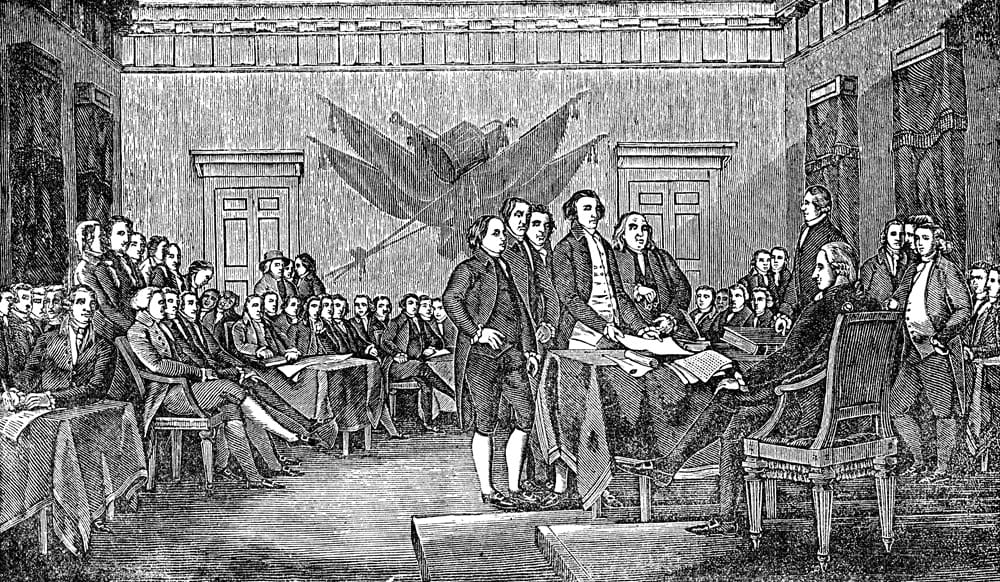
“Consent” is an interesting word. We find it in the thoughts of our fictional young man, but we also find it in the Declaration of Independence. In our last article, You Need a Charter, we learned the purpose of government is to secure rights given to us by God. In the same line of the Declaration, we further learn where the “just” powers of government come from. The document says governments derive “their just powers from the consent of the governed.”
As with many words in our founding documents, I like to look them up in Webster’s 1828 Dictionary to try to get closer to the definition our founders understood. That dictionary’s definition of “Consent” is the following:
“Agreement of the mind to what is proposed or stated by another; accord; hence, a yielding of the mind or will to that which is proposed; as, a parent gives his consent to the marriage of his daughter. We generally use this word in cases where power, rights, and claims are concerned. We give consent when we yield that which we have a right to withhold…”
Webster’s 1828 Dictionary, definition of “consent”
just powers
Especially in light of that definition from 200 years ago, and in light of The Declaration of Independence, that great charter document of American government, let’s think about what it means that the just powers of government are derived – or come from – the consent of the governed.
In our opening example of the young man headed to talk to the man he hopes will soon become his Father-in-Law… who do you think holds the position of power in the coming conversation? Who is the one asking for consent, and who is the one who will choose whether or not to grant it? In the example, it is the young man that is seeking consent from the father. So, the young man is nervous about how this conversation will go, and whether or not he will be able to secure the consent… NOT THE OTHER WAY AROUND.
You see, in the example story, the young man is the picture of the government. The father is the picture of the people – you and I – who will choose to either empower government, or not to, by either giving or withholding our consent.
Conversations with government officials
When we are getting ready to have conversations with our government officials, we often get these roles reversed. We may allow ourselves to feel we are groveling at the feet of the king. If we allow ourselves to reverse these roles, then we are like the girl’s dad waiting to see whether or not the young man will take our daughter – and acting like WE HAVE NOTHING TO SAY IN THE MATTER. That is not the American model. The American model of government is quite the opposite. In the American model of government, as described in the Declaration of Independence, the “just powers” of government are derived from the consent of the governed.
We have already discussed from the Declaration that the people receive rights directly from God. We see here that it is the people who organize and empower government. Not the other way around. We organize government and empower it for the specific purpose of securing unalienable rights that have been bestowed upon us by God Himself.
We the People
If it is the people who organize and empower government, then where or how do we see what powers we have given? For this, we find a familiar document – The Constitution of the United States. That document, of course, begins with the familiar words, “We the People of the United States… do ordain and establish this Constitution for the United States of America.” The people of the United States have established the Constitution for the purpose of outlining the specific details of how the government will work, and the details of exactly the powers we are granting them. We did this because the “just powers” of government are derived from the consent of the governed.
In other countries, perhaps the government may tell the people what they can or can’t do – in America, we tell government… and we tell them in the Constitution of the United States. Further, we also require every official at every level to swear an oath to support it before taking office.
Just vs Unjust
I keep using the word from the Declaration to describe those powers we delegate to government as “just” powers. That means, of course, that if the government would assume power contrary to the consent of the governed, then those assumed powers would be “unjust”. The Webster’s 1828 Dictionary sheds some light on the word “unjust”:
1. Not just; acting contrary to the standard of right established by the divine law; not equitable; as an unjust man.
2. Contrary to justice and right; wrongful; as an unjust sentence; an unjust demand; an unjust accusation.
Webster’s 1828, definition of “unjust”
Here we find that if the government would assume powers we did not give them in the Constitution – the document given for that purpose – then those assumed (stolen) powers are unjust! They are contrary to what is established by Divine Law! Why do we so consistently allow our government to operate in the realm of unjust powers? Why do we allow them to take what is not rightfully theirs? Why do we allow them to ignore the established principle of sticking to the just powers derived from the consent of the governed? Why do we so easily give up these truths for which our founders fought and bled?
Just powers of government are those properly designated to government in the Constitution. We have referred to them as “enumerated” powers in many other articles. We have to hold our officials to this limit! We must limit them to only carrying out the “just” powers of government.
Can We Change our Mind?
If we want to change the powers we have allocated to our government, then we can pursue an amendment to the Constitution, either through our representatives in Congress, or through a Convention of States. We talk more about constitutional amendments in our article, Can Americans Add New Enumerated Powers? An amendment to the Constitution is the correct way for government powers to evolve to new requirements. We cannot allow government officials to take it upon themselves to assume new powers that have not been granted by the people.
Conclusion
When we interact with our government officials, much like when a young man shows up to ask for our daughter’s hand in marriage, there is no reason to be rude. We do, however, need to remember and keep straight in our minds, who is asking who for what, and we need to remember that the giving of consent is our decision. Let’s not get this thing backwards.
We discussed an interesting interaction between a constituent and his Representative in our article, A Farmer’s Lesson on Holding Elected Officials Accountable.





0 Comments